
Turn Sunday’s sermon into your small group’s next conversation.
Everyone heard the same message. Sembrae turns it into a ready-to-run study guide — big idea, key Scripture, discussion questions, leader notes — and gives your group one place to keep the conversation going between meetings.
Works from a sermon you recorded, a link your church posted, or a transcript.
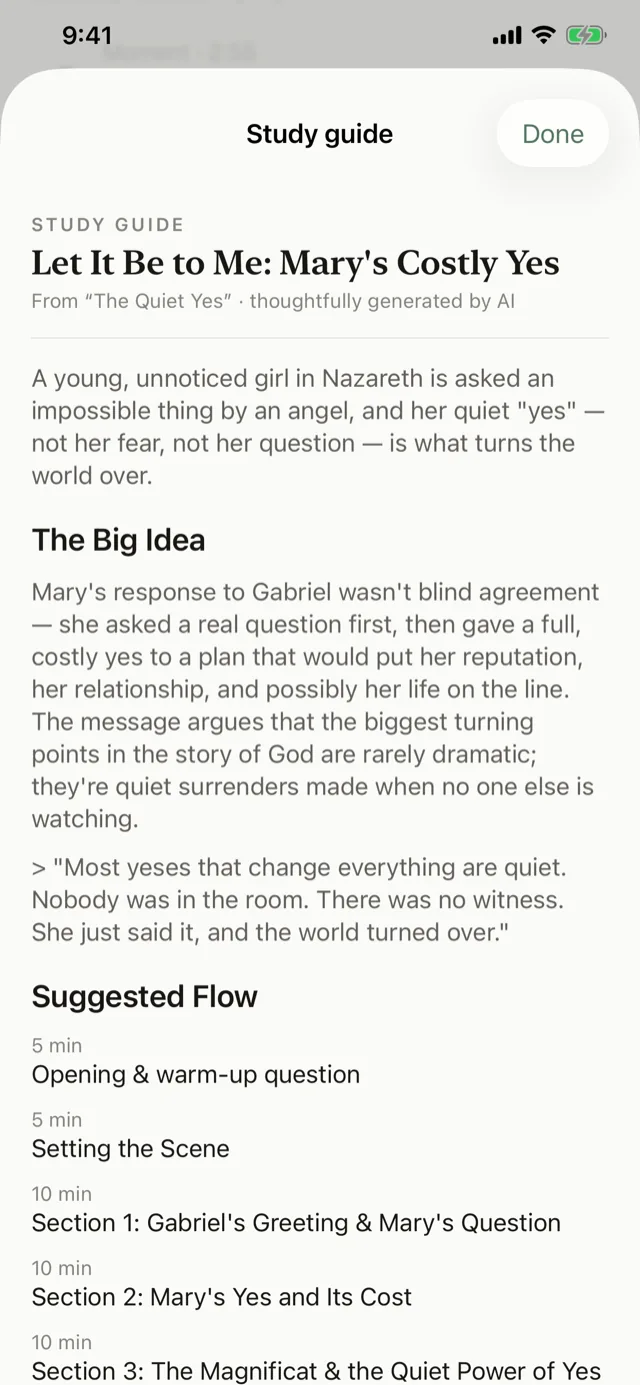
How can our small group discuss Sunday’s sermon?
Add the sermon to Sembrae — a free app that creates a Bible study from a sermon — and it writes a small group study guide from the message: the big idea, a suggested 45-minute flow, the main passage in context, two or three sections that follow the sermon’s movements with key points, Scripture, quotes and discussion questions, one step for the week, and a leader’s quick reference. Create a group, share the guide, and everyone can answer, reply and react — during the meeting and between meetings. Sembrae is free for every member.
Sunday worship, personal reflection, the group, the week — one thread
A sermon-based study is not a second curriculum. It is the same message, heard together on Sunday, lived with alone during the week, and talked through on Thursday.
- SundayThe whole church hears one message.
- ReflectionEach person reads the summary, or works through a devotional from it.
- Small groupThe study guide, and the conversation it starts.
- ApplicationOne concrete step for the week, chosen together.
What a sermon-based study looks like
Built from a fictional sermon on Hebrews 6:13–20, to show the shape. The real guide is written from your sermon’s own words.
Anchored: hope that holds
The big idea
Hope is not optimism about the future; it is an anchor fastened to a promise God has already sworn. The message traces Abraham’s long wait, God’s oath, and where the anchor finally holds — behind the curtain, where Jesus has gone ahead.
Suggested flow
| Time | Segment |
|---|---|
| 5 min | Opening question and prayer |
| 5 min | Setting the scene · Hebrews 6:13–20 |
| 25 min | Three sections · Talk about it |
| 10 min | Bringing it home and closing prayer |
Opening
When has waiting for something changed you — for better or worse?
Section 2 · A promise God swore
Key points
- God did not need to swear an oath; he did it “to show more abundantly” that his purpose does not change.
- Two unchangeable things — the promise and the oath — are the ground of the anchor.
Scripture
“In this way God, being determined to show more abundantly to the heirs of the promise the immutability of his counsel, interposed with an oath.”Hebrews 6:17 (WEB)
Talk about it
- Why would God bind himself with an oath to people who should already trust him?
- What is the difference between hoping something happens and hoping in a promise?
- Where in your life right now is your hope resting on a forecast rather than a promise?
Bringing it home
Each person names one anxiety and the promise they will anchor it to this week. Check in on it next time.
Everything a leader needs, from the message you all heard
Sermon recap
A faithful summary of the message and its movement, so the group starts from what was actually said rather than what each person remembers.
Key Scripture
The passages the sermon rested on, verified against the Bible, with how each was used. Open any of them in the app during the meeting.
Discussion questions
Three to four honest questions per section, grounded in the passage and the sermon — not a generic question bank.
Reflection and prayer prompts
An opening warm-up and prayer prompt, and a closing prayer, written for the message’s themes.
Practical application
One concrete step for the week in the guide, and daily next steps for each member between meetings.
A place to keep talking
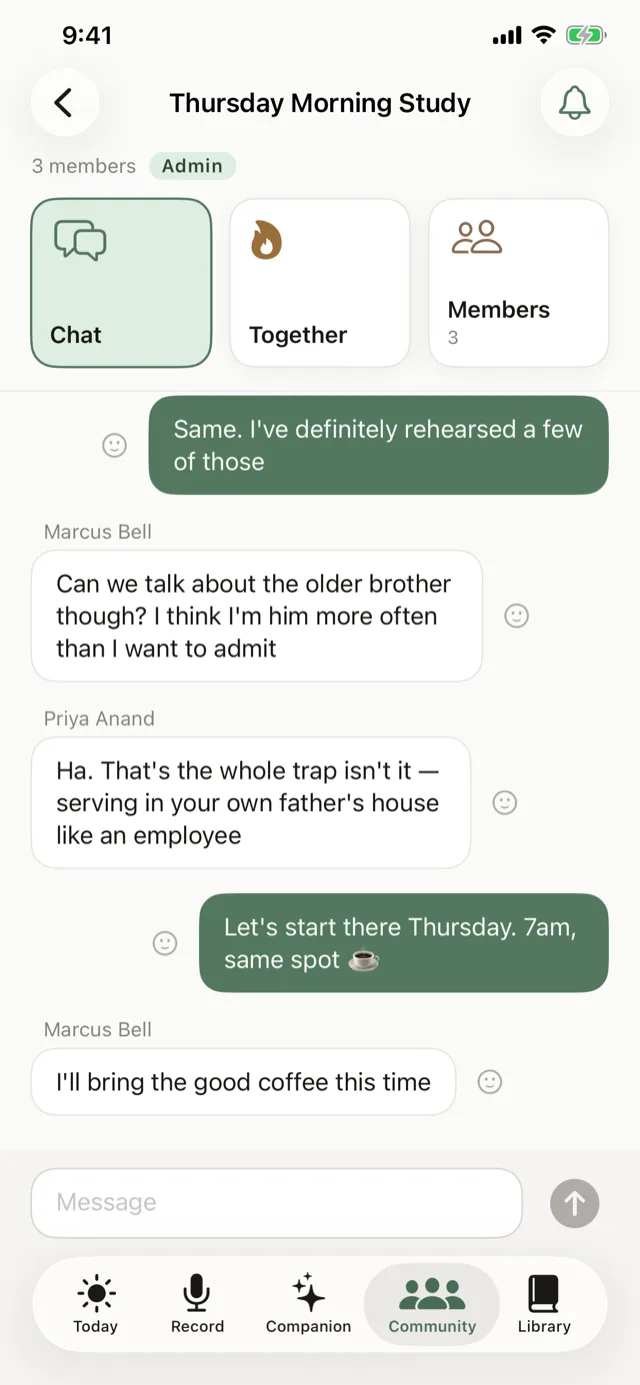
Create a group, invite friends, share the study. Answer the questions, reply to each other and react — with the Scripture a tap away.
The conversation does not have to end when the meeting does
Most groups meet once a week and go quiet in between. Sembrae gives the group a thread for each study: a question, the replies, the verse someone added, the reaction that says “me too.”
Members can also work through a devotional built from the same sermon during the week, so Thursday’s conversation starts from a message everyone has been living with, not one they are trying to recall.
Nothing here replaces the meeting. It just means the meeting is not the only time the group is a group.
For groups that want the sermon to be the curriculum
- Small group and life group leadersStop writing questions on Wednesday night. Generate the guide, read the leader’s reference, and spend your preparation praying for the people instead.
- Home churches and house groupsA ready-to-run 45-minute structure from any sermon you can add, with a family discussion guide available for mixed ages.
- Groups without a curriculum budgetSembrae is free for every member and sells nothing. The sermon your church already preached is the study.
- Churches that want continuitySermon-based groups keep the whole congregation in one conversation. Sembrae for churches drafts the guides in the church’s own voice, for leadership review.
Questions people ask
Can AI create sermon discussion questions?
Yes. Sembrae writes a small group study guide from the sermon you add, with three to four discussion questions for each movement of the message, an opening warm-up question, and a closing step for the week. The questions are grounded in the sermon’s transcript and the Scripture it cited.
Can I create a Bible study from a sermon?
Yes. Add the sermon and Sembrae generates a study guide for a roughly 45-minute gathering: the big idea, a suggested flow, the main passage in context, two or three sections that follow the sermon’s movements — each with key points, Scripture, quotes from the message and discussion questions — a closing application, and a leader’s quick reference.
How does a small group use Sembrae together?
One person adds the sermon and generates the study guide, creates a group, and invites the others. Everyone sees the same guide, answers the questions, replies to each other and reacts, with the Scripture a tap away — during the meeting and between meetings.
Does the group need the pastor’s permission or a church account?
No account from the church is needed. Any member can build a study from a sermon their church posted publicly or that they recorded and are allowed to use. If the church registers with Sembrae later, generated material shifts into the church’s own voice.
Are the discussion questions based on what was actually preached?
Yes. Every point in the guide is grounded in the transcript, and only Scripture verified against the Bible text is cited. Passages the sermon did not cite may be offered for further study, but are marked as such and never presented as something the pastor taught.
Can the guide be reviewed or edited by a leader before the meeting?
The guide is written as a draft for a leader to review, with a Leader’s Quick Reference at the end — the message in one sentence, the points at a glance, every Scripture referenced, and a few facilitation tips. Use what serves the group and leave the rest.
AI that serves the church, not one that replaces it
Grounded in the message
Everything Sembrae writes is drawn from the sermon you added and the Scripture it cited, and each point is cited back to its source. It carries the message; it does not invent one.
Not a substitute
AI-written material is labeled as such and is meant to be weighed against Scripture and your pastor’s teaching — not to replace either, or your church, your small group, your own study, or prayer.
Private, and free
Your journal, prayers and notes are encrypted and never shared. Sembrae is run by a non-profit, sells nothing, and is free for every member.
A study guide is a draft for a leader, written from the sermon. The leader, the group and the Scripture decide what is true; the guide just makes sure the conversation starts from what was preached.
More ways to carry Sunday into the week
Also:Sembrae for churchesWhat to do with your sermon notes after Sunday
Bring Sunday to your group this week.
Add the sermon, generate the study, invite the group. By Thursday you will have a guide everyone has read and a conversation already started.